
A few questions about a file, a project, or a conversation will reveal your pain
What failure looks like
Pick any random file in your organisation’s shared drive and ask:
- What was it for?
- Is it the only or latest version?
- Is it currently being worked on or used?
- When it’s needed, how will it be found?
- Who created or owns it? Who’s responsible for what happens with it?
- Is the information in it correct?
- Would someone like to know this exists?
Ask a random staff member:
- When was the last time it felt hard to find some information?
- When you start working on something, is all the information you need bundled with it?
- Have you recently had to re-do some work after finding out information was wrong?
- Is anything currently stalled due to lack of information?
- Do you remember a disagreement in a meeting because people had conflicting and incorrect information?
- If you were away for two weeks, could someone else pick up exactly where you left off?
Pick a random project and ask:
- Where’s all the information that’s needed to get this done?
- What’s waiting for information?
- What would be useful to know about this project that isn’t easy to find?
- How many different channels and sub-threads are being used to communicate about this project?
- What’s missing that a new person would need to pick up this project?
All of these questions, and many more, expose points of failure in your organisation. And those failures manifest in delays, inefficiencies, poor quality outcomes, frustrated staff, and missed opportunities.
Information is your foundation
In many organisations it’s possible to divide everything that happens into two groups. One is gathering information and verifying it. The other is applying skills and processes to that information to create and store the resulting information. Where the organisation is using and generating physical resources, you can imagine the same information flowing along one dimension of the process, while resources come in, are modified by information and processes, and are output along the other dimension.
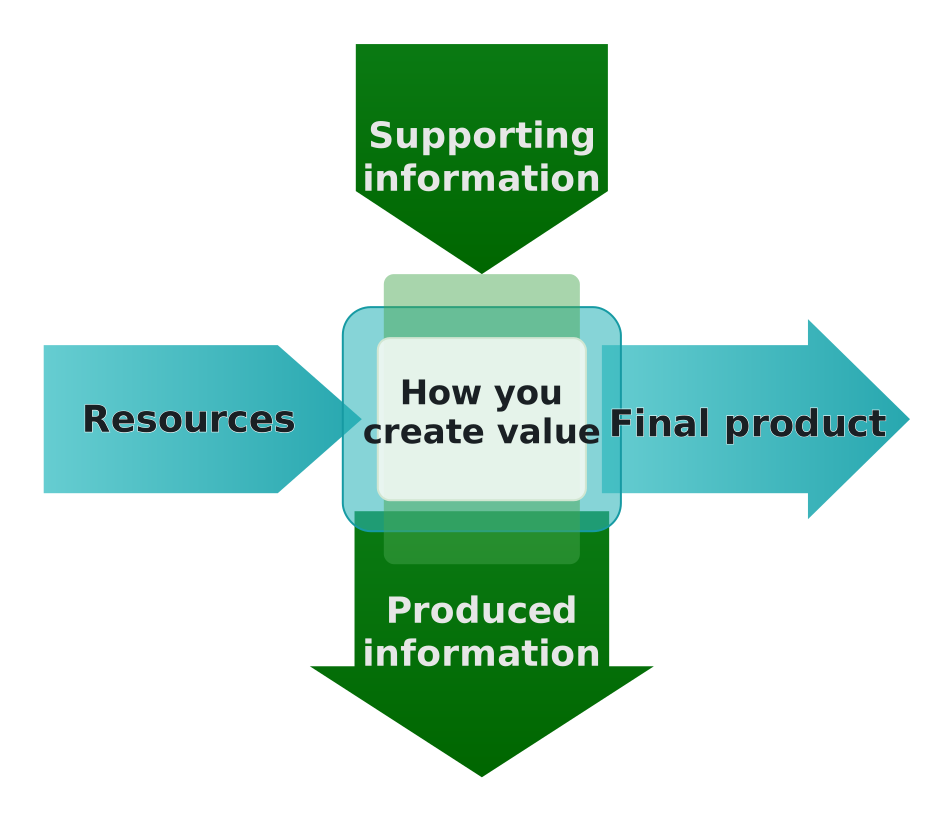
Obvious examples are in departments like accounts payable and accounts receivable. But if you think of everything that happens in an architectural firm, a legal office, or a government department, it is clear that it is all built on the flow and transformation of information.
The Ford Motor Company is often used as an example of how resources can be efficiently managed to come into a business, be transformed, and be reliably output. Think about how information enters your organisation, where it gets stored and created, what gets lost, duplicated, or forgotten about and what that would look like if it was all physical resources. It makes you wonder why we’re so focused on managing resources, but allow information to be scattered.
We experienced a slow transformation in our relationship with information. It has taken a long time to shift from paper in boxes to files in computers. And while uncountable tools to help us have been created, our culture and expectations about information management have been slow to change. One of the main reasons for this is how easy it is to generate and duplicate digital information. Despite being the foundation of your organisation’s success, it remains hard to value something that is generated so easily. But this ease of creation is the source of the problem.
The solution is not intuitive
You don’t need to try and slow down how much information is coming in or make it harder to generate information. The real solution is to make your information self-organising. Information is more useful and easier to find when it is connected to what it is about. To automate this you need the container that holds your information to be connected. And that system that connects everything together needs to automate things exactly how you want. That’s what the Complete Business Management Suite does. And it is so flexible that it encourages staff to extend it to meet their needs instead of trying to find some other solution.